Saturday, September 8, 2012

Public Art of Madrid

This small collection of photos hardly does justice to the massive amount of public art in the parks, plazas, and gardens of Madrid. They are just a few of my favorites.

Detail of pedestal in front of the Royal Palace. 
Detail of pedestal for a statue on Paseo Prado.

In the parkway on Paseo Prado

Statue in the Real Jardin Botanico

Top of the column above the Cervantes statue,
Plaza de Espana

Nymph in a pool at the Roseada,
Madrid's rose garden

Statue of Cervantes, with
Don Quixote & Sancho Panza
Plaza de Espana

The fate that befalls all statues....

Detail of a flamenco dancer and her admirers,
 on the Cervantes pedestal

When "Trickle Down" actually works.

Entry stairs in the CaixaForum
Madrid is "museum central". There must be 20 museums of various types scattered around the city, and that's not counting the marvelous parks, parkways, and botanical gardens which are artistic and "museumy" in their own ways.

Along the Paseo Prado are five art attractions: the Reina Sophia, the Prado, Thyssen-Bornemisza, the Real Jardin Botanico which is filled with statues, and CaixaForum. In addition, the Plaza de Neptuno and the Plaza de Cibeles feature incredible oft-photographed sculptures and dramatic fountains.

The unusual and modern museum is the CaixaForum. Caixa is pronounced Cah-ees-ah. In Catalan it means box. There is a bank named Caixa too. I didn't see anything to verify this, but I would guess that the bank might have a lot to do with the museum's existence.

Inside, the CaixaForum is reminiscent of the Guggenheim in New York City, the way the stairs wind upwards. On exhibit currently are many works of William Blake and of subsequent artists whom he inspired. Blake worked mostly in tempura paints which have not withstood the test of time well. Many of his works are faded, but what sensitivity! He was interested in the religions of the world, philosophy, and ancient art, attributes that made him an artist and poet well ahead of his time. He formulated his own mythology complete with heroic stories as well as the occasional buddhist thought. One quote was "If the doors of perception were cleansed, everything would appear to man as it is - infinite!"
Wall of living plants 

And on the outside, the building in front of the museum has been turned into a vertical garden. Concrete forms of various sizes with pools of dirt were built and then planted with a great array of different plants. The entire thing is watered with a system which trickles water down the wall, watering each plant as it makes its way down. The only reason it works is that no plant is denied in favor of others, and all the water trickles down, none of it is siphoned off at various levels. A good analogy for the economic trickle downers. The overall effect is a growing wall, lush with life.

Wednesday, September 5, 2012

The Royal Palace


I've been going to museums and grand open homes for years. It's always such a delight to see what 
the ultra-rich have put money into. Most of the best art and music in the world were the direct 
result of patronage by rich people, government, and churches. So, to see where much of the 
wealth that was sucked out of the Americas ended up, was mind-boggling.

The Royal Palace is billed as Madrid's most beautiful building, and there's no
doubt about that. It is a huge edifice, with gold and black lampposts in the
courtyard, an armory, a pharmacy, and the living quarters of the royal family.
Much of the palace is closed to the public, and is actually still used for state
occasions. One large reception room had a list of the incredible world events
that took place there, including Middle East Peace conferences and treaty
signings.

The kitchens and storage rooms that must surely exist were not on the tour, nor
were the servant quarters. But the throne room, reception areas, the King's
personal quarters, and many rooms that were used over the years for various
purposes certainly were. The most beautiful room of all was the king's dressing chamber!

Every square inch of floor, wall and ceiling was covered in some form of
exquisite art. The walls had "wallpaper". Certainly not paper, but material,
hand woven and then embroidered and brocaded with fine silk thread and even
threads made from silver and gold. Ceilings were painted with scenes from Greek
and Roman mythology, and in the chapel, the ceiling gave the impression that if
you prayed hard enough, you could rise up through it directly into heaven.
The floors were designs of inlaid wood, or in some cases, stone - rivaling the
malachite and ruby stone inlays of the Taj Mahal. Furnishings were carved, and
sometimes painted, or gilded. One room was entirely of porcelain. Beautiful
delicate porcelain vines and flowers, from pots rising up to the porcelain
ceiling with clouds. Each panel had been made to fit the room, and then put
together in such a way that the joining seams could not be seen. The dining room
was enormous, the floor covered in the largest handwoven rug I've ever seen.
Walls were often covered in tapestries, now hundreds of years old, and still
beautiful. Chandeliers hung in almost every room, made from silver and crystal.
Statues abounded, of marble, and by artists such as Goya and Titian. Paintings
by Goya and Rafael graced the walls, any one of which required a long perusal. And in the music room, five, (yes 5!) Stradivari violins and a viola.

Sunday was the last day for the bindings exhibit so I took advantage and saw
that as well. Books, too, were an exquisite art form, and were a substantial
part of the royalty's investment. The exhibit was in six rooms and featured
every kind of binding imaginable from carved stone and wood covers for books, to
hand lettered and painted books with leather binding, even one made from a
carved slab of malachite with gold metal edges and trim. In addition, there was
a desk carved and constructed entirely of malachite, a present from Russia.
Other book features were the painted and embossed edges, the paper itself part
of the aesthetics. I have never seen so many beautiful books!Photos inside the palace were not allowed, but there are some on the web. http://www.pbase.com/j_a_a/madrid_royal_palace  


Detail of the lamp post.


Sculpture on a corner of the Palace,

different ones on each corner of every wing.


Bas Reliefs are all over the place!


Monument in front of the palace


The Palace neighborhood.


Just a little view through the formal gardens...


The Palace Courtyard


Sunday, September 2, 2012

Big City Life - Madrid

It is difficult to have lived in Mexico, and then come to Spain and NOT make comparisons. There are so many contrasts. It's a bit more difficult to understand people here, they tend to slur words together a bit. And they have different words for things, especially modern things that get named something different when they come into existence.

And it's difficult, too, to compare essentially urban people with the more rural Mexicans that I came to know, even though they lived in a city. It wasn't a very big city, so they retained much of their rural culture. It would be like comparing Longmont, Colorado with London, England. They speak the same language, and eat many of the same foods, but otherwise, are quite different in social outlook and interests.

It's been fun mastering the Metro. Especially when I discovered the metro station for Cartagena street is several blocks closer than the one I'd been walking to. It turns out that once you're "in" the metro, you can go anywhere you want. In other cities, the money on your metro ticket isn't deducted until you leave the station by putting your ticket through the machine. If there's enough money on the ticket, it lets you out, if not, you're stuck until you add money to it. But here, I was able to purchase a 10 ticket pass for 12 Euros. So far I've used 4 of them. And each trip has been down two or even three different lines. It makes getting places fun, fast, and very easy. And knowing "my" lines, I can't really get lost in this city for long. A metro station will be someplace nearby and I can always get home.


Old trick from India
Home is a very nice apartment, a condo really. It's new construction, about six years old. The rooms are all pretty small, but there are built-in drawers in the closets, and lots of storage floor to ceiling, so it feels clean and organized. I rent a room and bath from a woman who advertised on AirBnB. Eva is a very nice person who speaks English quite well. She enjoys watching American TV programs like The Simpsons. She produces the nightly news for a Madrid TV station. She sleeps till about 10am then works till well after 8pm. I get the impression she can be quite the partier, as are many Madrilenos. So many of them stay out all night long that they are called "cats" (gatos). Renting from a local is such a good thing for me. Eva told me how to get around, where to go, what the "hot" spots are, what museums and sights are really worthwhile, which are merely tourist traps. It's also good to know that someone would know, and possibly care, if I didn't show up some evening.


Live sculptures - miners.
Of course, this is a super-tourist city. I must have heard fifteen different languages today, from eastern European to Chinese. Many signs and menus are in Spanish and English. And like many places inundated with tourists, the service people are a bit cool and unfriendly, though there hasn't been any overt hostility. There are a lot of little rip-offs, like not giving back the change after a transaction, like 30 cents doesn't matter.

And people love dogs! I've not seen a single cat as they probably stay indoors all the time, but dogs are out with their owners who even carry food and water for them in their bags.


A little cutie pie.

A lot of people earn a living performing on the street, and the buskers are quite creative. One pair uses an old trick from India where the support holding the "floating" man's seat is disguised in the sleeve of the man holding him up. Others dress up and act as mannequins, usually with some political purpose on top of the "performance". Many play instruments. In the metro, I heard what I thought was a live quartet playing Baroque music. Came around the corner to see a man "playing" one violin but the music included a coronet. Turned out, his whole deal was an act, the music came from an iPod put through an amplifier!! While walking down one of the traffic-free streets, lilting harp music was coming from a man wearing blue jeans and a big rodeo belt buckle . Turns out he was from Ecuador and once rode the bulls. Now that's a contrast of professions, from bull rider to street harpist. 


Saturday, September 1, 2012

Foodie Fun in Madrid


First day in the Capital of Spain, and at one time, capital of practically half the world. Much of the wealth sucked out of the Americas is still here in some form, in beautiful buildings, museums, and art. 


I spent some time matching the metro map with the map of the city. I'm staying with a lovely thirty-ish woman named Eva. She is a Madrilena, a native. We sat down for a little while last night,  she showed me all the great places to go. In the old elegant part of town, the Plaza Sol and the Plaza Mayor are the big gathering places, with massive numbers of shops and restaurants branching out in all directions. 


I took two metro lines to Plaza Sol and wandered around. I hadn't eaten breakfast at all, and it was already after noon. Tapas and a glass of wine seemed so romantic and Spanish. There was a small but crowded restaurant, called simply Cafe & Tapas, with outdoor seating in a deeply shaded patio. 


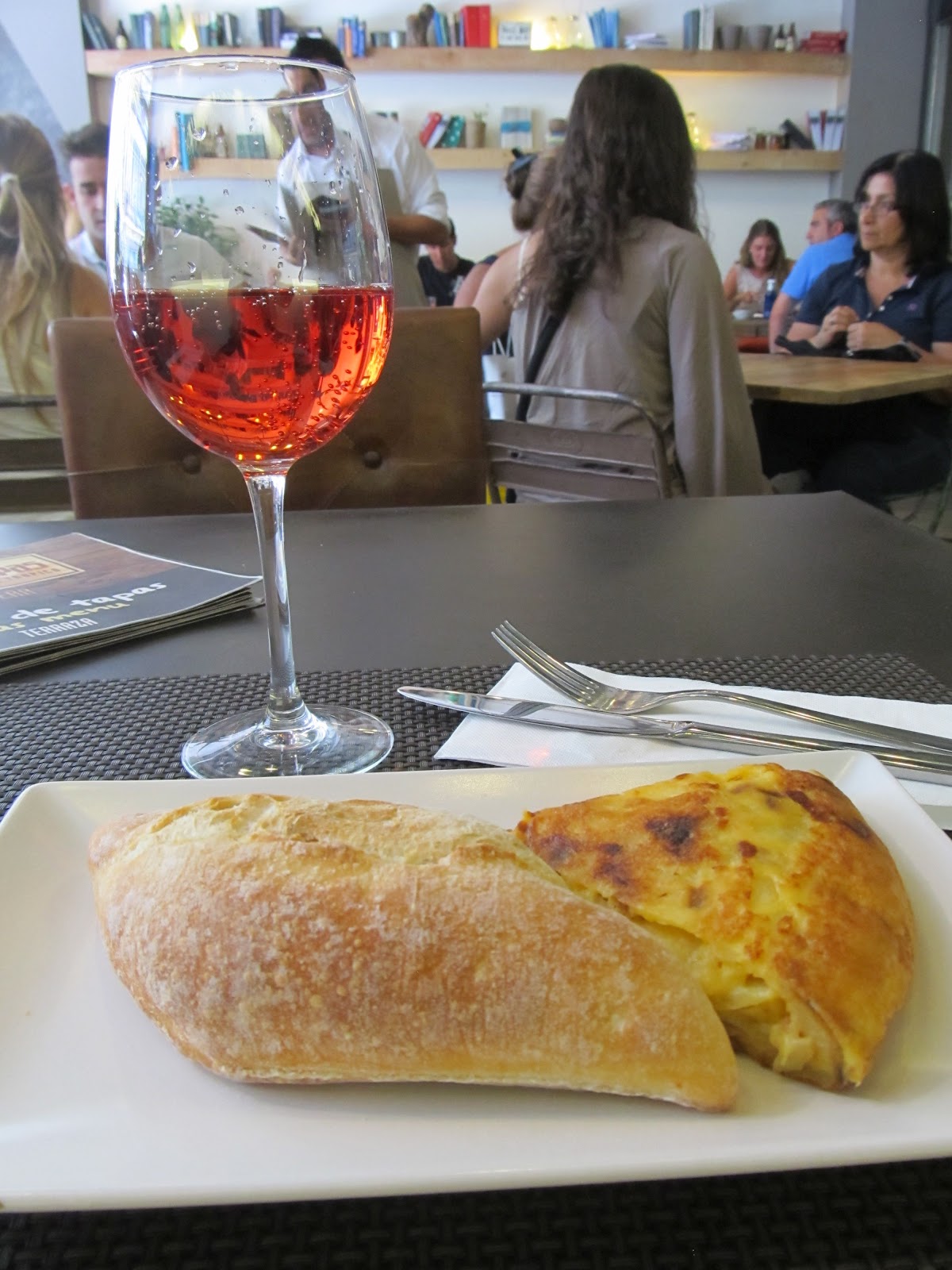
Tortilla Tapas & Vino
The Spanish make what they call a tortilla, but it's actually a potato pie. My Spanish teacher in Mexico, whose first husband was a Spaniard, showed me how to make it. Not something you want to try at home unless you have a fire extinguisher handy. It consists of small cubes of potatoes deep fried in olive oil until they are almost cooked, then egg is added to them and in a smooth (and practiced!) move, you flip the entire thing over in the pan to cook the other side. One wrong move and oil gets everywhere and can set the house on fire. 

At this little restaurant they had "pinchos" of different tapas, small servings, with a large hunk of bread. I ordered a sparkling rose and a pincho of tortilla. It was done to perfection, light potato flavor, almost crisp on both sides, and in a wedge shape. What a treat for my very first Spanish wine and tapas experience!!

Churros y chocolate
Another famous culinary sensation is a plate of freshly fried churros with a cup of thick rich chocolate. The most famous restaurant is the Chocolateria San Gines on Pasadiso San Gines 5. I'd heard it would be packed, but at 3pm it wasn't crowded at all. I paid E3.50, got my reciept and was met by a waiter who almost immediately brought the cup of warm thick pudding-like chocolate and a plate of churros. It was as "to-die-for" as anything ever recommended. I do believe they might have other things to eat there, but no one in the place was served anything different while I was there. 

Gelato artist and her rose creation!
As if the above weren't enough calories for a week, I wandered around up and down andadors (walking streets, cars get parked underground!) and came across a gelateria. The young lady inside fixed me a "small" cone in the shape of a rose, with as many kinds of icecream as I might like. If I'd known it was going to show up as a flower, I'd have picked other flavors that weren't brown, my choices were coffee and chocolate. Duh! But the rose was beautiful and the flavors exquisito together despite their lack of color contrast! 

More wandering about, visiting such oddities as the Ham Museum until I was exhausted, then I zoomed on back to the apartment on the Metro. I wasn't worried about getting lost. All I ever had to do was ask for the nearest Metro station, and I could figure out how to get back home once I know the name of that stop.  Madrid is going to be a fun experience for the next two weeks. But the food consumption has definitely got to slow WAY down!!

The morning run to the grocery, fruit, vegies, ham,
olives and coffee!

One of many displays at the Ham Museum! All
for sale along with cheap specials involving
a glass of beer and a sandwich.

Beautiful restaurant called the Cave.

Candies with embedded fruits and nuts!